
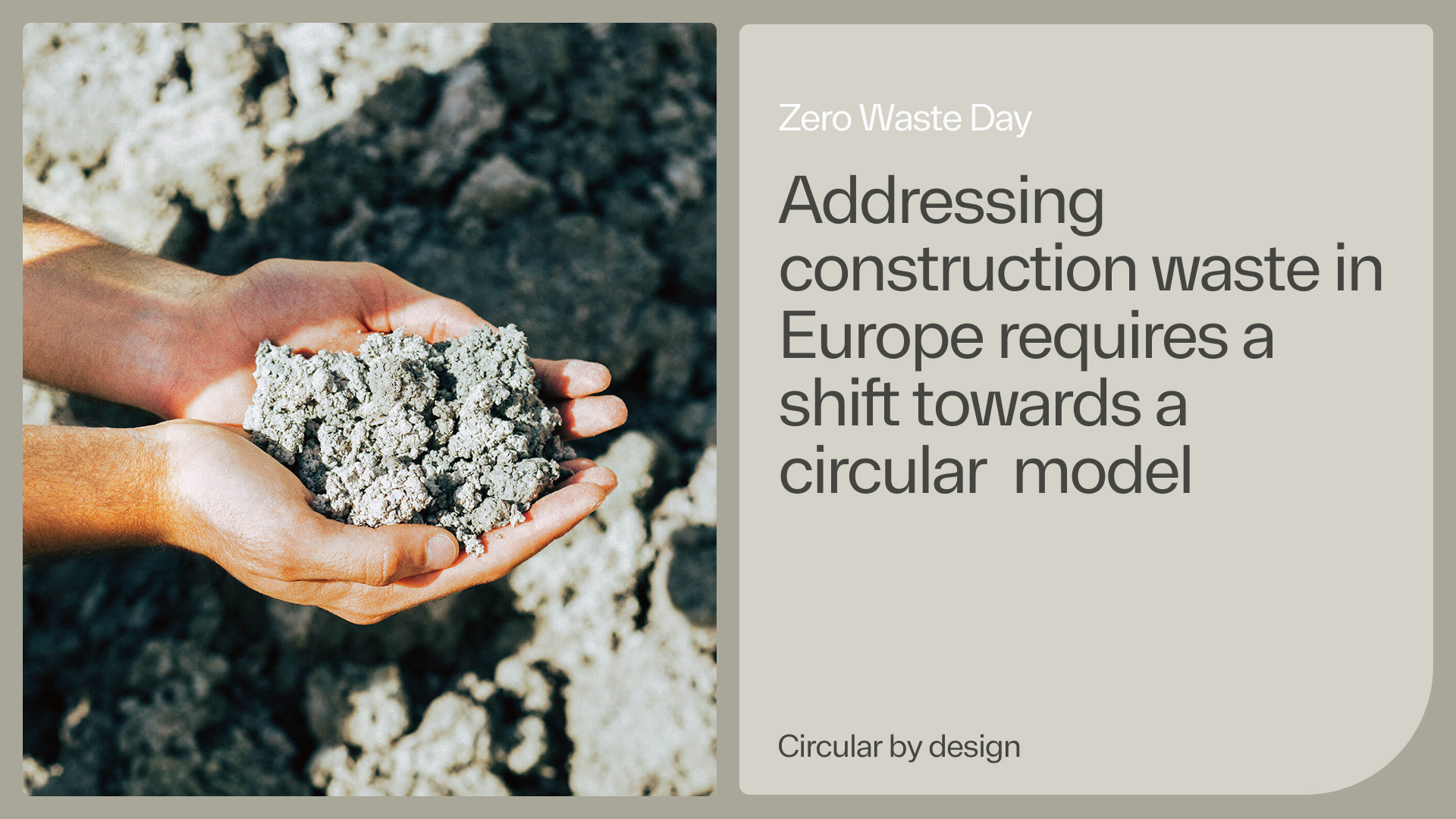
On Zero Waste Day, the spotlight turns once again to one of the most pressing challenges in the built environment: construction waste in Europe and its limited circularity.
Despite increasing awareness and regulatory efforts, the sector still operates largely under a linear model. Materials are extracted, used, and ultimately downcycled or discarded—rarely maintaining their value across multiple life cycles.
A system that recycles, but does not circulate
In the case of wood-based materials, recent research on panel manufacturing highlights a structural limitation: post-consumer wood in the EU typically goes through only one or, at most, two material cycles before being used for energy recovery.
This pattern is consistent across the broader construction sector. According to the waste management protocol developed by the European Commission, a significant share of construction and demolition waste is:
- Used as fill material or road sub-base
- Recycled only once in low-value applications
- Not recovered again at the end of its life cycle
In practice, this means that while recycling rates may appear high, true circularity in construction waste in Europe remains limited.
The structural gap: only 13–14% circularity
Data from the European Environment Agency confirms the scale of the issue.
For non-metallic minerals—including concrete, aggregates, and ceramics—the circular material use rate in the EU stands at just 13–14% in recent years.
This indicates that over 85% of materials do not re-enter the economy, reinforcing a system still heavily dependent on virgin resource extraction.
Recycling is not enough
The challenge is not only how much we recycle, but how materials are recycled.
Much of today’s construction waste in Europe is subject to downcycling, where materials lose performance and cannot be reused in equivalent applications. This prevents long-term circularity and accelerates material loss from the system.
From waste to resource: designing for circularity
Addressing construction waste in Europe requires a shift from end-of-life solutions to material design from the outset.
This is where new material innovations are emerging. HONEXT, for example, uses fibre waste from the paper recycling process—an underutilised secondary stream—to produce high-performance boards for interior construction.
Through its patented technology, HONEXT is able to:
- Stabilise and bind recycled fibres without toxic additives
- Deliver panels suitable for interior applications such as wall cladding, partitions, and acoustic solutions
- Create a material that is 100% recycled and recyclable again and again, enabling multiple life cycles
This approach demonstrates how construction materials can move beyond single-use recycling and become part of continuous material loops.
A turning point for the industry
On Zero Waste Day, the message is clear: solving construction waste in Europe is not just about increasing recycling rates, but about keeping materials in use at their highest value for as long as possible.
The industry already has the knowledge, technologies, and growing demand to transition. The challenge now is scaling solutions that enable real circularity.
Because in a truly circular economy, waste is not the end of a process—
it is the beginning of the next one.